
 English
 русский
 Español
 عربى
عربى

Why Do Commercial Freezers with the Same Specs Vary So Much in Price?
Content
- 1 Compressor Quality: The Heart of Every Freezer
- 2 Insulation Thickness and Foam Density
- 3 Sheet Metal Gauge and Interior Liner Material
- 4 Refrigerant Type and System Efficiency
- 5 Certifications and Compliance Standards
- 6 OEM Capability and Customization Depth
- 7 After-Sales Support and Warranty Terms
- 8 What "Factory Direct" Actually Means for Price and Value
- 9 How to Evaluate Price Differences Before You Order
Two commercial freezers. Same listed capacity. Same temperature range. Same exterior dimensions. Yet one is priced at $800 and another at $2,400. If you've spent any time sourcing refrigeration equipment, you've encountered this gap — and probably wondered whether the expensive one is actually worth it, or whether the cheap one is hiding something you'll regret later.
The short answer: yes, the difference is real — and it goes far deeper than brand markup. Here is a breakdown of exactly what separates a $800 freezer from a $2,400 one, even when the specification sheet looks identical.
Compressor Quality: The Heart of Every Freezer
The compressor is the single most important component in any refrigeration unit. It is also the component where manufacturers make the most aggressive cost-cutting decisions — without it showing up anywhere on the spec sheet.
A freezer rated at the same horsepower can use compressors from dramatically different tiers of manufacturing quality. Tier-1 compressors from established suppliers are built with tighter mechanical tolerances, higher-grade winding materials, and are tested under load conditions that simulate years of real-world use. Lower-cost compressors may meet the rated output at the moment of sale but degrade significantly faster under sustained commercial operating cycles.
For commercial buyers running units 12–24 hours per day, compressor longevity directly determines total cost of ownership. A freezer that costs $600 less upfront but requires compressor replacement within 3 years costs far more in the long run — not counting lost inventory during downtime.
Insulation Thickness and Foam Density
Insulation does not appear on a spec sheet. Yet it is one of the clearest markers of a quality freezer versus a low-cost one.
Two freezers with identical external dimensions can have wall insulation thickness that differs by 20–40mm, depending on how the manufacturer balanced build cost against performance. Thinner walls mean the compressor works harder to maintain temperature — especially in warm kitchen environments or during high-frequency door opening.
Beyond thickness, foam density matters. High-density polyurethane foam (typically 38–42 kg/m³) provides significantly better thermal retention than low-density alternatives (28–32 kg/m³). You cannot tell the difference visually or from a product listing. You can only determine it by asking the manufacturer directly — or by measuring energy consumption under real operating conditions.
| Insulation Factor | Budget Freezer | Quality Freezer |
|---|---|---|
| Wall thickness | 60–75mm | 80–100mm |
| Foam density | 28–32 kg/m³ | 38–42 kg/m³ |
| Temperature recovery (after door open) | Slower, more energy used | Faster, lower consumption |
Sheet Metal Gauge and Interior Liner Material
The exterior shell and interior liner of a commercial freezer carry more significance than most buyers realize. Thinner sheet metal (common in lower-cost units) dents, warps, and corrodes more easily in humid kitchen environments. Over a five-year operating period, surface degradation can create hygiene compliance issues — especially in foodservice settings subject to health inspection.
Interior liner material is equally important. The best commercial units use ABS (acrylonitrile butadiene styrene) or food-grade stainless steel liners, which resist cracking at sustained low temperatures. Lower-cost alternatives may use thinner ABS that becomes brittle over time or galvanized panels that can corrode when exposed to moisture from condensation cycles.
For commercial chest freezers used in seafood, meat, or pharmaceutical storage, interior liner integrity is a non-negotiable quality marker — because contamination risk increases the moment the liner begins to crack or chip.
Refrigerant Type and System Efficiency
Modern commercial freezers use one of several refrigerants: R134a, R290 (propane), R600a, or older R22-based alternatives. The refrigerant choice affects both energy efficiency and long-term regulatory compliance.
R290 and R600a are hydrocarbon-based refrigerants with very low global warming potential (GWP). They are more expensive to work with — requiring specialized handling during manufacturing and servicing — but result in meaningfully better energy efficiency and regulatory future-proofing as markets move toward lower-GWP standards.
Budget freezers frequently use R134a or older refrigerant blends that are cheaper to source and fill but carry higher GWP ratings and in some cases are being phased out under regional regulations. If you are importing into the EU or selling into markets with F-Gas compliance requirements, the refrigerant specification directly affects your ability to sell legally — regardless of the freezer's listed temperature performance.
Certifications and Compliance Standards
A commercial freezer carrying CE, ETL, or RoHS certification has passed third-party testing for electrical safety, electromagnetic compatibility, and hazardous substance restrictions. Obtaining and maintaining these certifications costs money — money that is built into the unit price.
Uncertified units are substantially cheaper to produce. They also carry significant risk for commercial buyers: customs detention, inability to obtain business insurance for covered equipment, retailer liability exposure, and in some markets, direct regulatory fines.
- CE certification — required for legal sale across the European Union and many associated markets
- ETL certification — recognized across North America, covering safety and performance standards
- RoHS compliance — confirms that hazardous materials (lead, mercury, cadmium, etc.) are restricted in the product's components
- Energy Star — indicates meeting efficiency benchmarks, relevant for markets with energy compliance requirements
When comparing freezers at different price points, always request the actual certification documents — not just a claim on the product listing. A valid CE mark will include the notified body number and a declaration of conformity document traceable to a specific testing facility.
OEM Capability and Customization Depth
Manufacturers who offer genuine OEM services — including custom branding, modified dimensions, alternative finishes, or application-specific component upgrades — carry higher fixed infrastructure costs. They maintain engineering teams, custom tooling libraries, and dedicated production lines capable of running smaller customized batches without quality compromise.
This capability is reflected in the unit price even for standard models, because the underlying production system is more sophisticated. A factory with robust OEM capability is generally better at quality control across its entire line, since the precision required for custom work demands tighter process standards.
Buyers who source from OEM-capable manufacturers also benefit from the ability to scale: if your standard model works well, you can later request modifications — logo placement, color changes, temperature range adjustments, or accessory integrations — without switching suppliers and restarting qualification processes.
After-Sales Support and Warranty Terms
The purchase price of a commercial freezer is only part of the real cost. After-sales support — including warranty coverage, spare parts availability, and technical assistance — has direct financial value that cheap units consistently underdeliver on.
A quality manufacturer will typically offer a 12–24 month warranty covering both compressor and electrical components, with documented spare parts availability and responsive technical support. Low-cost suppliers frequently offer nominal warranties with difficult claims processes, limited spare parts inventory, and customer service that becomes unavailable when problems arise post-shipment.
For commercial operators, a freezer that fails and takes three weeks to repair represents not just repair cost, but spoiled inventory, lost revenue, and potential compliance violations. This risk premium is real — and is one of the strongest financial arguments for paying more upfront for a unit from a manufacturer with an established support infrastructure.
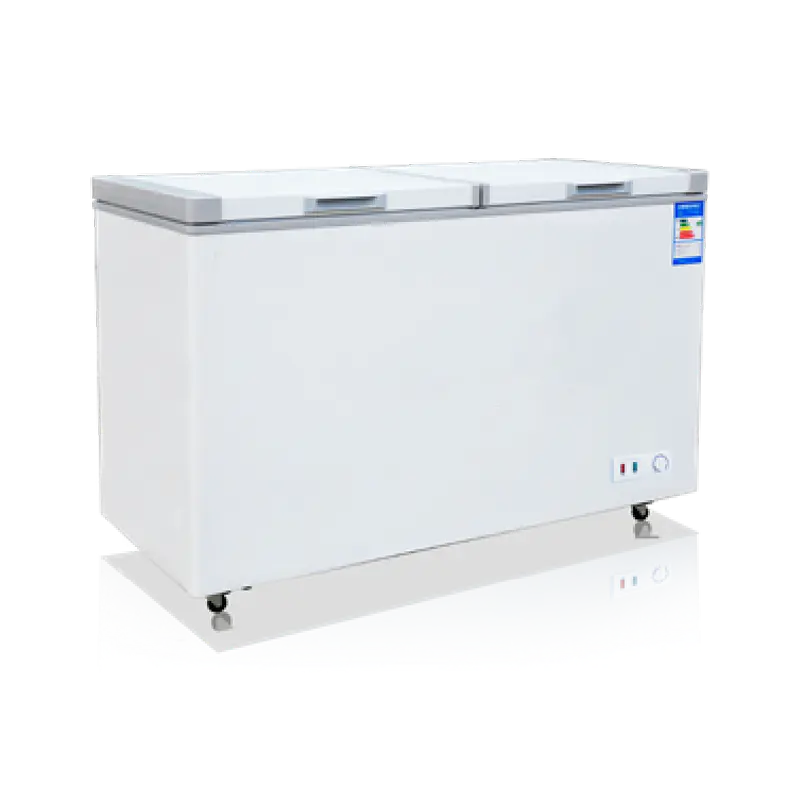
Consider also mobility requirements: for operations that reposition equipment regularly, units like chest freezers on wheels need caster systems rated correctly for fully loaded weights — another detail where specification surface-level matching hides significant quality differences between manufacturers.
What "Factory Direct" Actually Means for Price and Value
"Factory direct" pricing eliminates the distributor margin but does not eliminate the underlying cost of quality. A factory selling directly to international buyers at half the market price is not passing savings to you — it is producing a cheaper product.
Genuine factory-direct pricing from a quality manufacturer means you pay the production cost plus a reasonable margin, without a distributor's additional layer. This typically results in 15–25% savings versus buying through distributors — not 50–70% off market pricing. When prices look too dramatically low, the savings are almost always coming from reduced material grades, skipped testing, or uncertified components.
The most reliable way to evaluate a factory-direct offer is to request a factory audit, production facility photos with verifiable location data, and sample units for pre-order testing. Manufacturers confident in their quality will accommodate these requests. Those who cannot or will not are signaling that transparency is not in their interest.
If you are sourcing commercial refrigeration equipment and want to understand the specific construction standards and certifications behind our products, contact our team — we provide detailed technical documentation and factory visit arrangements for qualified buyers.
How to Evaluate Price Differences Before You Order
When comparing commercial freezers at different price points, use the following as your evaluation checklist:
- Ask for the compressor brand and model number — verify it independently
- Request wall insulation thickness and foam density specifications in writing
- Confirm the refrigerant type and GWP rating for your target market's regulations
- Request certification documents (not just logos) with notified body numbers
- Ask what the actual warranty claims process looks like — not just the listed duration
- Request a sample or third-party inspection before placing volume orders
- Evaluate the manufacturer's OEM experience as a proxy for overall production rigor
Price differences in commercial freezers are not arbitrary. They are the result of real decisions about materials, components, testing, and support infrastructure. Understanding what drives those decisions puts you in a far stronger position as a buyer — whether you are comparing suppliers for the first time or re-evaluating your current source.