
 English
 русский
 Español
 عربى
عربى

Chest Freezers on Wheels: Safe Mobility, Casters & Buying Guide
Content
- 1 Bottom line: the safest way to get a chest freezer on wheels
- 2 When chest freezers on wheels actually help
- 3 Built-in wheels vs freezer dolly vs caster retrofit
- 4 How to size casters for a chest freezer (with a simple example)
- 5 Wheel material and diameter: what rolls well on real floors
- 6 Stability and safety: locks, leveling, and compressor precautions
- 7 Setup tips that prevent wobble, noise, and ventilation issues
- 8 Comparison table: three ways to get chest freezers on wheels
- 9 Buying checklist: what to verify before you pay
- 10 Conclusion: choose mobility without compromising safety
Bottom line: the safest way to get a chest freezer on wheels
A chest freezer can be mobile without being risky—if the wheel system is sized for the real load and includes locks. The best setup is a purpose-built, lockable caster base (or a heavy-duty freezer dolly) rated above your fully loaded freezer weight. Avoid light furniture casters: a freezer’s weight is concentrated, and rolling vibration can stress frames and floors if the wheels are undersized.
Practical rule: estimate your fully loaded freezer at 300–700 lb for common household sizes (freezer + contents), then choose wheels with 30–50% headroom to handle bumps, thresholds, and uneven garage slabs.
When chest freezers on wheels actually help
Wheels are most useful when you regularly need access around or behind the freezer, or you expect to reposition it seasonally or during cleaning. In garages and utility rooms, mobility can prevent “dead zones” of dust buildup and makes it easier to keep clearance around vents.
Good use cases
- Cleaning behind/under the freezer every few weeks
- Tight spaces where you need to roll it out to access baskets or an outlet
- Garage workshops where you reconfigure layout for projects
- Small retail/back-of-house areas (with proper commercial-rated bases)
When wheels are not the best idea
- Uneven floors where the freezer would rock or drift even with locks
- High-traffic areas where bumping is likely
- If you plan to roll it frequently while fully loaded (better to reduce load first)
Built-in wheels vs freezer dolly vs caster retrofit
“Chest freezers on wheels” usually means one of three approaches. The safest choice depends on how often you move the unit and how much load it carries.
1) Built-in wheels (manufacturer base)
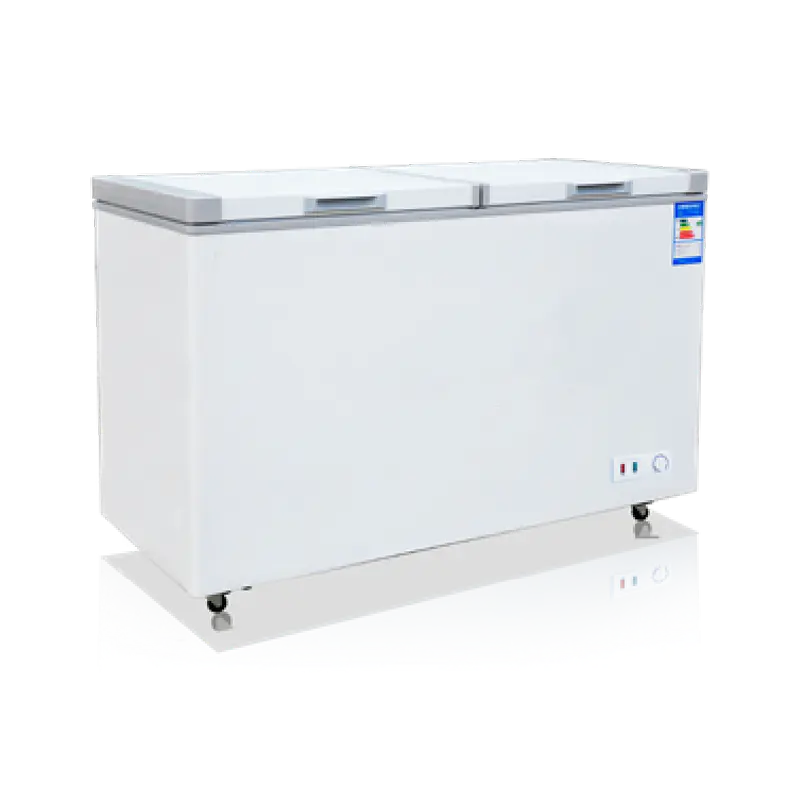
Convenient and tidy, but verify the wheel rating and whether the casters lock. Some built-in setups are intended for occasional repositioning, not heavy rolling.
2) Freezer dolly (platform with casters)
Often the best balance: the freezer sits on a rigid platform designed to distribute weight. Look for corner stops, straps, and lockable casters.
3) Caster retrofit kit (casters mounted to the freezer)
Works when done correctly, but it can be the riskiest: drilling or bolting into the freezer base can compromise structure or warranty. If you retrofit, choose a kit specifically intended for appliance loads and confirm attachment points won’t damage tubing, wiring, or insulation.
How to size casters for a chest freezer (with a simple example)
Correct caster sizing is the difference between smooth, stable rolling and cracked floors or bent frames. You want each wheel to carry its share of the load plus extra capacity for shocks (thresholds, seams, rough concrete).
Step-by-step sizing
- Estimate freezer weight (empty). Many household chest freezers fall around 150–250 lb, depending on size and insulation.
- Estimate contents. A reasonably stocked freezer can add 100–400 lb (meat, bulk items, ice, bins).
- Add a safety factor of 1.3–1.5× for rolling impacts and uneven load distribution.
- Divide by the number of casters (usually 4) to find the minimum per-caster rating.
Example calculation
If your freezer is 200 lb empty and you estimate 300 lb of food, that’s 500 lb total. Multiply by a 1.4 safety factor: 500 × 1.4 = 700 lb. For 4 casters: 700 ÷ 4 = 175 lb per caster. In practice, you’d choose casters rated at 200 lb each or higher.
Why the extra margin matters: when you roll over a lip or crack, one caster can briefly carry far more than 25% of the load. Overrating improves stability and wheel life.
Wheel material and diameter: what rolls well on real floors
For chest freezers on wheels, floors vary: smooth tile, vinyl, sealed concrete, or rough garage slabs. Matching wheel material and size to your floor prevents chatter, dents, and “flat-spotting.”
Material cheat sheet
- Polyurethane: durable, rolls smoothly, good for concrete and indoor floors; common “best all-around.”
- Rubber: quieter and gentler on floors; can roll well on slightly uneven surfaces but may have higher rolling resistance.
- Hard plastic/nylon: strong but noisy; can mark some floors and transmit vibration—usually not ideal for home use.
Diameter guidance (practical ranges)
Bigger wheels handle cracks and thresholds better. For many homes, 3–4 inch casters are a sweet spot for garages and utility rooms, while 2–3 inch can work on smooth indoor flooring. If you routinely cross door thresholds, larger diameters reduce the “bump” that stresses mounts.
Stability and safety: locks, leveling, and compressor precautions
Mobility should not turn into sliding or tipping. A loaded chest freezer is top-heavy once the lid opens and baskets shift. Prioritize lockable casters (at least two, ideally four) and a base that resists racking.
Safety essentials
- Use total-lock casters when possible (locks wheel rotation and swivel) to reduce drift.
- Keep the freezer on a level surface; if your floor slopes, consider a base with leveling feet or chocks.
- Avoid rolling with the lid open; shifting weight can amplify tipping risk.
- Move slowly and clear the path first—cords, mats, and transitions are the most common “snag points.”
After moving: protect the compressor
If you keep the freezer upright and only roll it a short distance, many owners still wait a bit before powering on to let refrigerant oil settle. A practical guideline is 2–4 hours if it stayed upright; if it was significantly tilted, waiting longer (often up to 24 hours) is the cautious approach. Always follow your specific manufacturer instructions when available.
Setup tips that prevent wobble, noise, and ventilation issues
Most performance issues with chest freezers on wheels come from poor fit: a base that’s too small, casters mounted unevenly, or blocked airflow. Take ten minutes to measure and you’ll avoid repeated adjustments later.
Checklist before you roll it into place
- Measure the freezer footprint; the dolly/base should support the full perimeter, not just the corners.
- Confirm ventilation clearances on all sides; don’t let a base skirt or straps block vents.
- Keep the cord slack and routed so it cannot get pinched under a wheel.
- If using a dolly, use non-slip pads or corner stops to prevent “walking” during lid opening.
Noise control (especially on concrete)
If rolling noise is a problem, switch to polyurethane or rubber casters and consider a thin, dense mat under the freezer’s parking spot (not under the rolling path). Also re-check caster bolts after the first week—settling can loosen hardware.
Comparison table: three ways to get chest freezers on wheels
| Option | Best for | Pros | Watch-outs |
|---|---|---|---|
| Built-in caster base | Light repositioning, cleaner look | Integrated fit, minimal setup | Verify lock function and weight rating; some are not designed for frequent rolling |
| Freezer dolly/platform | Most homes/garages needing regular access | Spreads load, easy to replace wheels, often safest | Must match footprint; needs corner stops/strap to prevent shifting |
| Caster retrofit kit | Special cases where a dolly won’t fit | Can be compact; tailored wheel choice | Highest risk of poor mounting/warranty issues; must avoid damaging base structure |
Buying checklist: what to verify before you pay
If you want chest freezers on wheels that feel stable and last, check these details in the product listing (or measure them yourself).
Caster and base specs to confirm
- Load rating (total and per caster) with 30–50% headroom over your estimated fully loaded weight
- Locking mechanism: at least 2 locks; ideally total-lock on all 4
- Wheel diameter: 3–4 inch for rougher concrete or thresholds; smaller only for smooth indoor floors
- Wheel material: polyurethane or rubber for quieter rolling and less floor marking
- Base rigidity: a flexy platform increases wobble and caster wear
- Fit: platform supports the footprint and doesn’t block ventilation
Quick questions that reveal quality
- Are the caster ratings listed as static, dynamic, or both?
- Does “locking” stop swivel, roll, or both?
- Is there a stated maximum platform load and a recommended appliance type?
- Can you replace the casters later with the same plate pattern?
Conclusion: choose mobility without compromising safety
Chest freezers on wheels are a practical upgrade when you size the casters for the fully loaded freezer and prioritize locks and rigidity. For most homes, a heavy-duty freezer dolly with lockable 3–4 inch polyurethane casters and 30–50% load headroom is the safest, most flexible option. Once installed, keep the freezer level, lock it in place during normal use, and move it slowly only when necessary.